


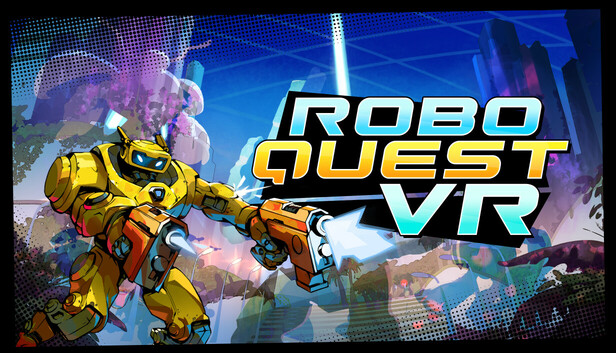
When two people on your team argue over who’s the bigger RoboQuest fanboy — and both of them are sitting well past 100 hours in the game — you get a pretty good sense of how this project started.
Before RoboQuest ever came to VR, Impact Reality and Flat2VR Studios COO Eric Masher had already sunk around 125 hours into the original flatscreen roguelite. Lead designer Tsveten had gone even further: all achievements unlocked, countless runs, and, as he jokes, “probably 126 hours” — just enough to stay ahead.
That level of obsession is important, because RoboQuest VR isn’t a quick “slap motion controls on it” port. It’s a case study in how to turn a beloved PC/console title into a true VR-first experience — one that keeps all the depth and scope of the original while fully embracing what makes VR special.
And it all started because a fan took a plane to Sweden, uninvited, to knock on a publisher’s door.
From Superfans to Developers
Unlike a lot of studios where leadership treats games purely as a business, this team lives in roguelites.
Eric describes himself as someone who “tests a lot of games” for work — which also happens to be the excuse he gives his wife and daughter when they catch him grinding another run. He first discovered RoboQuest on Steam as a standard flatscreen shooter and immediately recognized something important:
This felt like a VR game waiting to happen.
The movement, the scale of the arenas, the verticality, the fast-paced combat — none of it raised the usual red flags that make some flatscreen games terrible VR candidates. Instead, it felt like the original devs might have had VR in the back of their minds the whole time.
So after Trombone Champ VR, Eric went to his partners — Jasmine Uniza (CEO/producer), Skiva, and Elliott — and said:
“One of the first games we should try to get is this amazing roguelite published by Starbreeze. They’re in Sweden. Can I go to Sweden and talk to them?”
What he actually meant was, “Can I fly across the world, completely uninvited, walk up to Starbreeze’s office, and ring the bell?”
Somehow, the answer was still yes.
Eric showed up at Starbreeze’s door, snapped a photo of their nameplate, sent it back to the team, and rang. By sheer luck, the head of business development was there, had time after lunch, and invited him up.
Eric pulled out his laptop and started showing what Flat2VR Studios had done with Trombone Champ in VR. It impressed them so much that the BD lead literally pulled the Payday dev team out of their meeting to come over and watch. They crowded around a tiny table, looking at a laptop screen, to see what this little VR studio was doing.
That impromptu demo is where the RoboQuest VR story began. The contract followed not long after.
Why RoboQuest Feels Better in VR
At its core, RoboQuest is a fast, kinetic roguelite shooter with heavy emphasis on movement and verticality. On a monitor, you get a taste of that. In VR, you live it.
For Eric, the biggest difference is scale:
“The second level is this vertical city. On a 27-inch monitor it’s cool, but when you’re in a headset, standing on those skyscrapers and physically looking down, the sense of height and scope is something you just can’t get on a flat screen.”
Players often only see the early canyon level and don’t realize how vertical later stages become. In VR, that verticality hits harder: grappling across gaps, climbing, dropping off ledges, and lining up aerial shots all feel more intuitive when your whole body is engaged.
Lead designer Tsveten, a lifelong shooter fan, loves how VR changes the feel of combat:
- Left hand firing the grappling hook
- Right hand deploying ability devices or weapons
- Head and torso tracking independently as you scan for threats
You’re not just pressing keys to dodge and strafe — you’re physically turning, leaning, reaching, and reacting. The result?
“It almost feels like a different game. You start approaching levels differently. Once you play in VR, going back to flat, you expect a certain intensity that just isn’t the same.”
A Full-Fat Roguelite in VR — Not a Tech Demo
One of the most striking things about RoboQuest VR is what didn’t get cut.
The original flatscreen game was in development for around five years with a team of roughly 30 people. It’s packed with content:
- 80+ weapons
- Multiple classes
- Procedurally generated maps
- Deep perk and upgrade systems
Producer Jasmine Uniza came into the project without much history with the flatscreen version. From her perspective as a fresh RoboQuest player, the sheer amount of content was shocking:
“This game is loaded. VR sometimes gets this reputation for feeling like tech demos or watered-down versions of non-VR games. RoboQuest VR is stacked to the gills. You’ll get at least 125 or 126 hours in it.”
Eric puts it more bluntly: most roguelites built from the ground up for VR are great ideas constrained by budget. They tend to be shallower, with fewer weapons and less long-term progression. RoboQuest, on the other hand, is a full-fledged PC/console game dropped into VR almost intact.
“People have been asking for years: don’t give us a VR tech demo, give us the full game. RoboQuest is that — a traditional PC/console roguelite with hundreds of hours of content, now in VR.”
Rethinking the HUD: Information on Your Hands
One of the hardest parts of bringing RoboQuest to VR wasn’t enemies or levels — it was the HUD.
On a monitor, your health, cooldowns, minimap, level-up notifications and status effects can all float at the edges of the screen. In VR, cluttering your view like that is a fast track to discomfort and confusion.
So Tsveten and the team set themselves a challenge:
How do you surface all that information only when needed, without ever leaving VR’s sense of presence?
The answer was simple in theory and beautifully executed in practice:
put the UI on your body.
The Wrist-Mounted Minimap
In the flatscreen game, you rely on a minimap overlay because the levels are huge and procedurally generated. In RoboQuest VR, that minimap has been moved to your left wrist, like a holographic watch.
- Flick your wrist up: a projection of the map appears.
- Keep shooting with your right hand while you glance at routes or enemy positions.
- Red dots show enemy locations, letting you track that one sniper you can’t visually spot.
Eric, who always used the minimap flat, calls this one of his favorite changes:
“Being able to check the map while shooting with the other hand — that’s just not even possible in the traditional game.”
Ironically, Tsveten barely used the minimap in flatscreen, but in VR he calls it a must-have. That’s how natural it feels to just raise your wrist mid-firefight.
Gadgets on Your Arms
To handle health, cooldowns, and other key data, the team leaned into a similar approach: forearm gadgets.
Your robot avatar doesn’t just hold guns — your arms are now wrapped with small devices displaying information through animations, sparkles, and visual cues. It’s not just functional UI; it visually reinforces the fantasy that you are a futuristic combat bot, wired up with tech.
Perks You Physically Grab
The perk system is one of RoboQuest’s best features, but in the flatscreen game there’s a common problem: you’re in the middle of chaos, a tiny “Level Up” indicator pops up, and you completely ignore it. Players often end up with multiple unspent perks without realizing it.
In VR, the team flipped that experience.
When you level up:
- You feel a rumble in your controller.
- A device on your hand emits sparkles, drawing your eye.
- A set of perk cards appears in front of you.
You literally reach out, grab a card, inspect it, and choose your build. It’s tactile and impossible to ignore — exactly the way a roguelite should feel in VR.
The design goal was clear: make leveling up feel like a physical moment rather than a UI popup. According to the team, it worked. Testers stopped missing their upgrades and started engaging with the depth of the perk system far more consistently.
80+ Weapons, 80+ Ways to Reload
If there’s a single area where the VR conversion screams “labor of love,” it’s the weapons.
In flatscreen RoboQuest, guns are wildly diverse — from junk rifles to absurd cannons to water guns and more. In VR, every one of those weapons now has its own manual reload logic:
- Eject magazines
- Slam in fresh mags
- Grab and insert huge shells
- Fiddle with stranger mechanisms on exotic guns
You can inspect every weapon closely, admire the design, and then learn each reload as its own little micro-game.
“It was a sizable challenge to bring every weapon’s reload into VR,” says Tsveten. “But I actually prefer manual reloading now — that extra step of physical immersion just feels right.”
For Jasmine, who doesn’t consider herself a “shooter person,” this turned every loot chest into a little moment of joy:
“Every time I open a new box, it’s like a goodie bag. The gun isn’t just new stats; it feels new in your hands. When I paired the Beluga Cannon with an ice perk, it was like snow falling on Christmas Day.”
Status Effects You Can See and Feel
Another area the team refused to phone in was status effects.
On a monitor, fire, freeze, or stun are often conveyed through screen tints and UI symbols. In VR, that can be messy, or even nauseating, if overdone. Instead, RoboQuest VR does something smarter:
- On fire? Your hands and weapon ignite.
- Frozen or slowed? Your hands and gun take on icy effects.
- Stunned? You’re knocked slightly “out of your body,” with your hands frozen in mid-air.
To break out of a stun, you perform a small physical mini-game: shake your controllers to snap back into action. It’s the VR equivalent of the flatscreen version’s “hit W-W-A” type key sequence — but way more entertaining to watch.
Jasmine tells a story of seeing Eric do this in person during a work trip:
“He’s in the headset, bracelets and watch jingling, just shaking as fast as he can. He looked like a little kid who’s way too excited for school. It was hilarious — and all born out of the team refusing to just map it to a button press.”
This Is Not a Mindless Shooter
Under the chaos, RoboQuest is a deeply strategic roguelite.
Eric’s biggest piece of advice for new players: take perks seriously.
Every time you level up, you get four choices. They might boost:
- Health or shields
- Movement speed
- Specific weapon types
- Resource pickup range
- Elemental or status effects
- Or niche mechanics that completely change your run
There are thousands of potential perk combinations. On top of that, between stages you can invest in meta-progression and weapon upgrades, layering long-term strategy on top of moment-to-moment choices.
“Every decision you make affects how far you get,” Eric says. “Take your time. Read your perks. Build the run you want instead of just clicking the first one to get back to shooting.”
This isn’t just theory. Even with hundreds of hours in RoboQuest, Eric watched Jasmine unlock perks he had literally never seen before while she went on a monster run that earned an S rank. That’s how deep the system goes.
Explore Everywhere: Secrets Reward Verticality
If perks are Eric’s obsession, exploration is Tsveten’s mantra.
“If you see a ledge, climb it. See a door, open it. Look for waterfalls. Look for buttons — especially red ones. There are hidden things everywhere.”
Once you unlock all the gadgets, RoboQuest VR gives you the freedom to really lean into its vertical design. Climbing, grappling, and parkouring your way through arenas isn’t just for style points — it often leads to secrets and rewards.
In VR, that sense of exploration hits harder. Looking down from a high ledge you just scaled yourself feels fundamentally different than simply holding a jump button on a controller.
Launching on Eric’s Birthday
RoboQuest VR is launching on PlayStation VR2 and SteamVR on November 20, which also happens to be Eric’s birthday — an unplanned but perfect gift for the guy who flew across the world on a hunch that this game belonged in VR.
From obsessive fans to uninvited doorstep pitches to carefully reimagined mechanics, RoboQuest VR is more than a port. It’s an argument for what VR conversions can be when you respect both the source material and the medium you’re moving into.
It keeps the content, the depth, the replayability — the hundreds of hours and 80+ weapons — and then layers on:
- True sense of scale and verticality
- Physical reloading and weapon handling
- Body-based UI and wrist-mounted tools
- Perks you grab with your own hands
- Status effects you can see and feel
If you’ve ever wished VR would stop giving you “almost” versions of full games and deliver the real thing, RoboQuest VR is exactly that wish made real — with a grappling hook, a junk rifle, and maybe a frozen Beluga cannon in your off-hand.